This 11 September, exactly 10 years after the Twin Towers of the World Trade Centre fell, politicians and relatives of the victims will gather in a grove of 415 trees planted on the event's charged ground. Two huge cascades of water, each occupying the square footprint of one of towers, will start churning, ceaselessly, forever. Inscribed in a bronze strip surrounding the cascades will be the names of those killed in the 9/11 attacks, including those at the Pentagon and on United flight 93, which crashed in a field in Pennsylvania, as this is the national 9/11 memorial, not just New York's. The memorial will be ready, just, although it will be accessible only by advance booking for another two years. It could not miss this deadline. Despite billions of public dollars, thousands of ideas for memorials and rebuilding, a shared public desire to honour the event and speeches by governors and mayors about the urgent need to get things done, perhaps a third of all the reconstruction that will happen here has so far taken place. Work on 7 World Trade Centre, a relatively plain tower at the edge of the site, was completed in 2006. Otherwise, the grove and the fountains stand among pits, canyons, cranes and rising frames, a Bosch landscape of machines and mud, of digging down and piling up, as skyscrapers, a train station, a museum and 550,000 sq ft of retail space take shape.
It is very New York, is what everyone connected with the project says, by which they mean that everyone has an opinion and an interest, which must face down the opinions and interests of others. Much of the past decade has been spent in arguing, in law courts, in the media, at public and private meetings. Relatives of victims had different views from one another, and from people living near the Ground Zero site, who did not want their neighbourhood to become a shrine to catastrophe. One of the residents' leaders was told she would "burn in hell". Construction became political: protestors against slow progress carried placards saying: "Don't forget 9/11. Delay means defeat." There was rage and defiance, a desire to stick it back to the terrorists, which made it very likely that large towers would be put back on the site.
In the years following 9/11, the event was honoured by a carnival of pretention and viciousness, as architects felt compelled - as there can be narcissism in healing - to put themselves at the centre of the stage cleared by the attacks. "We're going to crush his nuts," said one of another, while others preened and posed and drivelled about the fusion "of military and urban space" or new towers that would "kiss and touch and become one". They employed black propaganda, old boys' networks, emotional posturing and shameless spinning. At stake was the greatest commission in the world, the chance to shape 16 acres of Manhattan property that were also the site of the most momentous event of the 21st century thus far. It was not just about the memorial but about the towers, station and museum that would go on the site as well.
The way they were: the World Trade Centre’s twin towers dominate the New York skyline in the 1990s. Photograph: Peter J. Eckel/Time & Life Pictures/Getty
After a false start or two, several architects were asked to take part in an "innovative design study", a process that was not supposed to have any winners. Then a winner was chosen, a group called Think, a decision overturned the next day by George Pataki, the governor of New York State, who chose Daniel Libeskind instead. Libeskind's design studies were then called a masterplan, even though there had not been the time or money to work them out as fully as a masterplan would normally be. They then acquired the status, at least for some politicians, of designs for individual buildings, which they were not either. What were essentially sketches were treated as blueprints for multibillion-dollar structures.
Libeskind is the Polish-born son of Holocaust survivors, and designer of the Jewish Museum in Berlin, who, as a teenager, had arrived in New York, in the time-honoured way of immigrants, by boat. He was well placed to speak of freedom, hope, conflict and tragedy. His proposals, in which fractured geometric forms rose into a triumphant spiral said to echo the Statue of Liberty's torch, soaked the site in symbols. Its pinnacle would be the tallest building in the world - 1,776ft high in honour of the date of the American Declaration of Independence - which Pataki would name the Freedom Tower.
Nor was Libeskind afraid, though no Republican, to borrow the Bushite warping of language that followed 9/11: "Freedom" to mean "America", "heroes" to mean "victims". He called his project "Memory Foundations" and said it represented "life victorious". Libeskind is intelligent - when he received news of his win he was reading God, Death, and Time by the talmudist Emmanuel Levinas - but he can sound remarkably simplistic when he wants to. There was a snag. "That idiot," as one of his rivals puts it, uncharitably, "he forgot that most American of things - the contract." There were in fact other architects engaged to work on the site, the giant, business-friendly practice Skidmore, Owings & Merrill. SOM had been hired by Larry Silverstein, the developer who bought a long lease on the towers in the summer of 2001, a few weeks before they fell, and they were still his architects. His lease required him to put back all 10 million sq ft of the office space destroyed, so his views mattered. According to Janno Lieber of the Silverstein Corporation: "Larry said to Libeskind, 'Congratulations, this is a phenomenal plan. You've managed to accommodate everyone. But - no disrespect - I'd like my architects to design the individual buildings.'"
The main man at SOM was David Childs, now aged 70, prominent for decades in American architecture but never adulated like its more glamorous stars. His style is courteous but ruthless, that of one used to getting his own way. The project was also personal for him, as it was for many. A member of SOM's staff was killed in the attacks and Childs and his team had all too good a view from their Wall Street offices, a few blocks away. "There was a young man with tears streaming down his face," recalls Childs. "He said, 'Will they fall?' I said, 'No.'"
Pataki pushed Libeskind for a while but, according to Childs, Silverstein needed architects with experience of large buildings, such as SOM. Libeskind wanted to design the Freedom Tower, the most conspicuous element of his plan, but found himself put in a junior partnership with SOM ("We're a team organisation but we needed 51% of the vote," is how Childs describes it). Then he became an increasingly marginal figure as Childs redesigned the tower as he wanted it. The outcome of the Childs/Libeskind showdown is now the most prominent object in the place that in the 1960s was named the World Trade Centre, became Ground Zero in 2001 and now - to lighten its load of significance - is called the World Trade Centre again. The rising tower, its slick skin chasing its steel-and-concrete frame up to the sky, is already taller than anything in Britain but still far from its final height. Libeskind wanted a dynamic, asymmetrical shape but the tower will now be a symmetrical obelisk, in emulation of the Washington Monument in Washington DC. Childs calls it "iconic and simple".
The Freedom Tower, now renamed 1 World Trade Centre, looks assertive and confident, like the towers of corporate America anywhere, but it has contradictions. It is unsure if it is a symbol or a piece of commercial real estate. Childs refers to the Washington Monument but also cites the importance of "market realities", among other things, as a reason for discarding Libeskind. Yet its size is grandiose and its security measures elaborate, for obvious reasons, which make it expensive in a location that is not New York's hottest commercial spot. It does not obviously respect market realities. At least, it did not convince Silverstein, who refused to build it, meaning that the Port Authority of New York and New Jersey, the public body that owns the freehold, decided to put its own funds into putting up the tower, with uncertain prospects of an early, sufficient return on its investment.
Freedom Tower nears completion. Photograph: Rowan Moore for the Observer
The tower is the pinnacle of Childs's career, as it would be of any architect's, yet he is openly contemptuous of what might seem an important design feature, its height. This, achieved with the help of a large steel stick, retains the magic number specified by Libeskind: "1,776 feet, whatever that's worth," says Childs. "Nobody's going to count the feet."
The rebuilding of Ground Zero is an immense public building project, consuming billions of public dollars, pushed by mayors and governors, of a scale that would impress an old-fashioned socialist despot. Yet it is also a commercial development by the Silverstein Corporation. Its most important guiding document is Silverstein's lease agreement of summer 2001 and its requirement, blind to the imminent attacks and the emotional charge they would bring, that any destroyed accommodation should be put back. It meant that, whatever else happened, there would be very large office blocks on the site.
None of the powerful people involved with the site since then has been able or willing to change this requirement. At the same time, it was impossible for anything built there not to be a symbol, given what had happened and given the geometric potency of the Twin Towers. Their architect, Minoru Yamasaki, dreamed, with hopelessly misplaced optimism, that they would become "a representation of man's belief in humanity, his need for individual dignity, his beliefs in the co-operation of men, and through co-operation, his ability to find greatness". The fearful symmetries of their downfall, and the contrast between the perfection of their forms and the chaos of their collapse, ensured that architecture and construction were enmeshed in the event. Hence the contradictions. Is it a symbol? Is it an office block? It is both.
What are most clearly symbols are the two square cascades of the memorial, which lie in front of the tower in an eight-acre plaza containing the grove of 415 trees. The memorial is by Michael Arad, the architect who won a design competition held in 2003-4, beating 5,200 entrants. He was 34 at the time, unknown and inexperienced, and has realised the work in partnership with the well-established landscape architect Peter Walker. Arad was living in Lower Manhattan at the time of the attacks and, like many, "was very affected by what I saw and felt compelled to do something about it". He recalls the place as a "ghost town" after 9/11, but with people instinctively gathering at night in public places such as Washington Square. From this, he learned that "public spaces are the glue that binds society together".
Almost immediately, Arad started imagining a memorial, spending "a lot of time and effort drawing and sketching and modelling". He came up with two squares set in the Hudson River, "with the surface of water torn open, by voids that will never fill". Then the competition was announced and he adapted his idea to the location at Ground Zero. At the same time, inspired by his discovery of the power of public space, he wanted them set in a large, flat, open plaza. He called his plan "Reflecting Absence" and won. For Walker, the main problem was maintaining the flatness and openness of the plaza, which was essential to Arad's design, without making it bare and arid. The most important part of the answer is the trees, selected and nurtured, with great difficulty, so that they are all the same size.
Both Walker and Arad had to fight the many pressures to put unwanted stuff in the empty space, such as skylights for the train station or 17 air vents 20ft high. "How can you make something flat with 17 vents in it?" says Walker, who needed Pataki's help to sort out that one. They had to find the right kind of seating: park benches seemed inappropriate but so did oblong slabs that "looked as if they might have a dead person underneath"; so the slabs had to be given dimensions that made them look less tomb-like. They had to make the cascades work, with the help of a mock-up in Toronto, and Walker still sounds a caution. "We've made them as well as we know how, but they're mechanical and usually mechanical things only last 30-40 years." Somehow, the money will have to be found to pump the water round for ever and ever. You get the impression Walker would not have gone for fountains if it had been up to him.
Arad wanted the names of the victims to be inscribed near the bottom of the cascades, with visitors descending to them behind the screen of falling water. Cost and security issues made this prohibitive and the names will now be around the cascades' upper rim, at the level of the plaza. Even this simpler presentation took years to resolve, not least because of the question of the order in which the names, which include the six people who died in the 1993 attack on the World Trade Centre, would be arranged. Should they be alphabetical? Should they be random? Eventually it was agreed that names should be arranged by groupings of place - who was in which tower, on the ground, in which plane or in the Pentagon. However, relatives were invited to make "meaningful adjacency requests", of which 1,200 were received, whereby they could ask for particular names to be together.
Arad's and Walker's other concern was, as it was for most who have touched this site since 2001, the balance of remembrance and renewal. "A lot of people," says Arad, "thought it had to be either a living park or a cemetery and a forever dismal place." The combination of the fountains and the canopy of trees is intended to house both death and life, both acts of pilgrimage and lunchtime sandwich eating by office workers. "You walk through trees," says Walker, "and suddenly these waterfalls open up underneath you. Then you turn around and you're in a forest, which is a symbol of life."
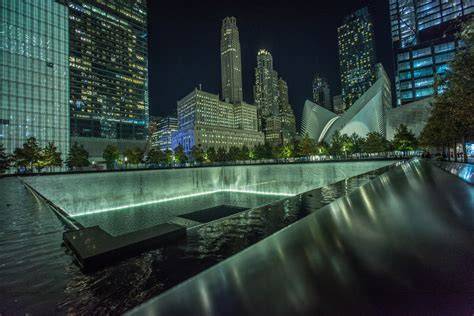
Newspaper critics are being kept at a distance from the memorial for now, but it is possible to see from surrounding buildings that each fountain is vast. As each of each square's four sides is more than 200ft, and there are two squares, the total length of falling water is nearly a third of a mile. Each cascade drops 30ft, before dropping another 30ft down a smaller square hole in the centre, down to the level of the bedrock under the site. But they are not the end of the remembering. Beneath the plaza, a museum is being built, with 100,000 sq ft of exhibition space. Exhibits will include crushed cars and fire trucks, twisted metal from the old towers and photographs and remembrances of victims. Within the museum's vast spaces it will be possible to see the slurry wall, the rough concrete that kept out the waters of...
Bolond gazda az, aki a vetőmagját elkótyavetyéli. Aki másét, az pedig gonosz. Az európai kultúra részévé vált magyarság történetében is az ifjúság lett a remény szinonimája, a változások idolja, a jövő vetőmagja. Sajnos a Fidesz első kormányzása óta módszeresen számol le az ifjúsággal. Tovább>>