Alopecia syphilitica is a less common clinical manifestation of secondary syphilis.
Abstract szerint a syphilisben szenvedő betegek mindössze 4%-ánál fordul elő alopecia sifilitica, mely 5 eset kapcsán kerül bemutatásra a vonatkozó irodalmi áttekintéssel együtt.
All of the patients in our series were men aged between 31 and 46 years.
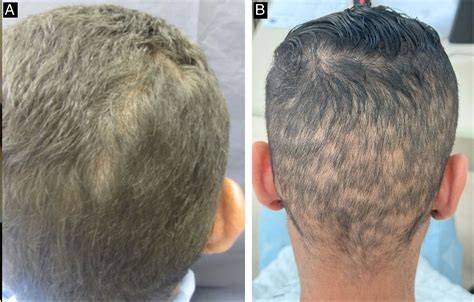
A tünetek általában a tarkó-fejtető tájékot érintik, és jellemzően moth-eaten vagy patchy mintázatot mutató, nem hegesedő alopécia-foltokat eredményeznek.
One patient initially presented diffuse alopecia with multiple erythematous scaling lesions.
Immunohistochemical staining revealed the presence of numerous spirochetes in the hair follicles in the 2 patients in whom skin biopsy was performed.
Visitors attending follow-up showed improvement after treatment.
Dermatologists should maintain a high level of clinical suspicion for this uncommon manifestation of syphilis, particularly when it is the only symptom.
Bevezetés és megjelenés
IntroductionSyphilis, also known as the great imitator, has not been eradicated and physicians should maintain a high level of diagnostic suspicion.
In addition to the usual forms of presentation, very rare cutaneous manifestations can appear and sometimes make diagnosis difficult.
Syphilitic alopecia (SA) is an unusual manifestation of syphilis infection we should be familiar with, given the progressive rise in the number of cases of syphilis in Spain in recent years.
This increase in the incidence of syphilis means we are more likely to see patients with atypical manifestations or with neurological complications in our routine clinical practice.
We present 5 cases of SA and review the literature.
Esetleírások és kórisme
Case DescriptionsFor this study, we gathered all cases of SA diagnosed in the dermatology department of Hospital General Universitario de Valencia, Spain, between May 2007 and May 2011.
Of a total of 81 patients diagnosed with syphilis, 57 had secondary syphilis.
Alopecia was observed in 6.17% of all 81 cases of syphilis.
All were men aged between 31 and 46 years and, on questioning, all reported high-risk sexual behavior.
Serology was positive for reagin and antitreponemal antibodies in all patients, and 2 of them were also found to be positive for HIV infection.
Physical examination revealed multiple plaques of nonscarring alopecia, predominantly affecting the parieto-occipital region.
The plaques varied in size, did not present signs of inflammation or desquamation, and were not completely devoid of hair-they had the characteristic moth-eaten or patchy appearance.
One patient initially presented with diffuse alopecia associated with numerous desquamating erythematous lesions on the scalp.
After the first dose of antibiotic he developed a Jarisch-Herxheimer reaction with high fever, malaise, generalized joint and muscle pain, and marked worsening of the alopecia.
The majority of patients reported other associated manifestations that could have suggested syphilis.
Histology in case 2 revealed irregular epidermal hyperplasia and a dense lymphohistiocytic inflammatory infiltrate with a lichenoid distribution at the dermoepidermal junction.
Immunohistochemistry showed the presence of numerous spirochetes with evident tropism for blood vessels and the perifollicular epithelium.
Dermatologist interventions included intramuscular penicillin G benzathine, 2.4 million units, with clinical improvement in subsequent follow-ups.
Formák és patogenezis
SA is an unusual manifestation that only occurs in 4% of cases of syphilis.
Symptomatic SA is rare with associated skin lesions on the scalp, usually in the form of papulosquamous lesions.
The second type, essential SA, is characterized by hair loss with no other visible syphilitic lesions on the scalp.
Moth-eaten or patchy pattern is the most common form and is characterized by small scattered plaques of nonscarring alopecia with irregular borders in the parieto-occipital region.
Diffuse SA represents widespread telogen effluvium-type hair loss without obvious plaques, while mixed SA combines both elements.
Histology commonly preserves the epidermis with follicular hyperkeratosis; psoriasiform hyperplasia with a lichenoid infiltrate may be observed.
Immunohistochemistry frequently reveals spirochetes in the perifollicular areas, supporting a direct pathogenic role.
Terápia és lehatások
The therapeutic approach to SA is identical to that for other patients with secondary syphilis.
The treatment of choice in immunocompetent individuals is an intramuscular dose of 2.4 million units of penicillin G benzathine.
In HIV-infected patients, weekly doses must be administered for 3 weeks.
Hair loss can be temporarily exacerbated by a Jarisch-Herxheimer reaction after starting treatment, but the hair loss is reversible and typically resolves within 8 to 12 weeks after therapy.
Early treatment is important to avoid potential late complications such as central nervous system involvement.
SA may sometimes be the only manifestation of secondary syphilis, underscoring the need for high diagnostic suspicion to prevent late or incorrect diagnoses.
Trichoszkópia és diagnózis differenciálja
Trichoscopic features may facilitate SA diagnosis, though findings are often non-specific.
The moth-eaten pattern commonly presents with empty follicles, short regrowing hairs, decreased hair per follicular unit, and an erythematous background.
Diffuse patterns show decreased hair per follicular unit and short regrowing hairs; mixed patterns may reveal yellow dots.
Absence of exclamation mark hairs can aid in differentiating SA from alopecia areata.
Klinikai összefoglaló és kimenetel
All patients who attended follow-up improved after treatment, with significant hair regrowth noted within months after the end of therapy.
SA can be detected more frequently than literature suggests, since some cases present with SA as a sole symptom of secondary syphilis.
The dermatologist plays a crucial role in recognizing SA and initiating appropriate serological testing for syphilis when encountering nonscarring patchy alopecia of the scalp.
Táblázat: SA jellegzetes jellemzői
| Jelleg | Leírás |
|---|---|
| Pattern | Moth-eaten, patchy, diffuse, mixed |
| Érzékelhető terület | Parieto-occipital region predominantly |
| Biopszia | Follicular hyperkeratosis, lichenoid infiltrate, spirochetes |
| Treatment | Benzathine penicillin G 2.4 MU IM; HIV esetén 3 hétig hetente |
| Prognózis | Hair regrowth általában teljes követő 8-12 hét |
Isabella Doche about syphilitic alopecia
Az SA felismerése és a megfelelő szekunder szifilisz-kezelés elengedhetetlen a késői szövődmények elkerülése érdekében.
tags: #alopecia #syphilitica #areolaris #leirasa