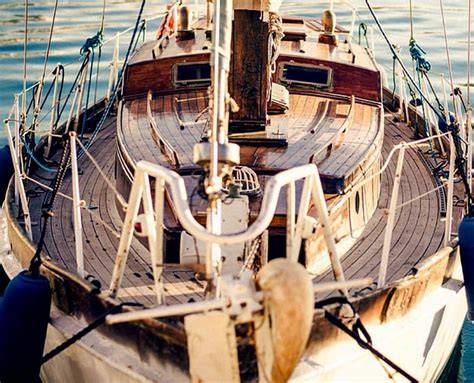
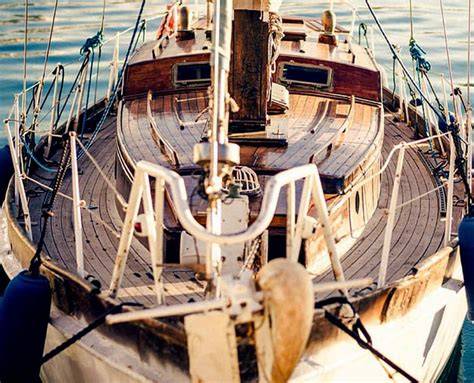
Above deck: On the deck - not in the cabin. Abrest: When two boats are facing in the same direction, side by side, at the same speed and position. Adrift: A boat floating loose, without moorings, tow rope or using power. Aft: The stern part of the boat or when you’re to the rear of the boat. Aground: When a boat is touching the bottom in water too shallow for its draft. Ahead: An area in front of the boat you are on, and to go ahead is to go forwards. Aids to Navigation: Any signal, marker, or equipment that aids a boat to navigate safely, including channel markers and isolated danger. Aloft: The area above a boat’s deck - usually in the rigging or on the mast. Amidships: In the middle of the boat between the stern and the bow. Anchorage: An area suitable (e.g. harbour or island cove) suitable for a boat to stay and deploy and anchor.
- Horgonyzóhely: Olyan terület (pl. Apparent Wind: The apparent wind is a combination of the true wind and the wind caused by the boat’s movement through the water. Autopilot: A self-steering mechanism on a boat. Bailer: A container used to remove water from a boat in the event of water ingress. Backing Wind: Refers to the wind shifting direction in an anti-clockwise direction. Backstay: Part of the rigging running from the top of the mast to the stern of the boat. The backstay stops the mast from falling forward and, when tuning a boat’s rig, it also helps to control the degree of mast bend. - a kötélzet egy része, amely az árboc tetejétől a hajó faráig tart (árboc feszítő kötél két oldalt és hátul).
Batten: Wood, fiberglass or plastic strip slid into a pocket on the leech of the sail. Battens help to shape and strengthen the sail to increase overall performance. - latni: fa, üvegszálas vagy műanyag lap, amit a vitorla zsebbe csúsztatunk. Batten down: Fasten hatches and loose objects on deck and down below to prevent things from moving, or becoming damaged. Beam: The widest point of the boat. Beam Reaching: A point of sail when sailing directly sideways to the wind on either a port or starboard tack.
Bearing Away: Steering the boat away from the wind or turning downwind. Beating: Sailing towards the wind by tacking back and forth across the wind. Belayed: Secured, tied to, made fast to. Bend on: To secure one thing to another. Bilge: The lowest area inside a boat’s hull, below the floor. Bilge pump: A pump to remove any water in the bilge. Bitter end: The free end of a line - it’s where the term, ‘until the bitter end’ comes from. (The other end is referred to as the ‘Standing Line’).
Boat Wind: The wind created by the boat moving through the water. Boat hook: A pole with a hook on the end for picking up mooring buoys or recover items dropped over the side. Bollard: Wooden or iron post on a dock to secure the boat to. Boom: The horizontal pole or spar running aft fat a right angle from the mast to which the foot of the mainsail is attached. Bow line: The mooring line leading from the front of the boat. Bowline Knot: A strong, but easy to untie knot that creates a loop in the end of a line.
Bridge: The room/platform onboard a ship where the vessel is controlled from. Bridle: A V-shaped line attached to the boat’s mooring system. Broad Reach: A point of sail when sailing downwind off to the port or starboard side. Bulkhead: An often watertight, interior wall on the boat. Buoy: Anchored navigation floats to mark hazards or for mooring to.
Cable: Measurement of distance equal to 0.1 nautical mile. Capsize: When the boat turns over in the water and is no longer upright. Cast Off: Releasing the boat’s lines allowing it to leave its mooring. Centreboard: A pivoting board lowered through a slot in the hull or keel to prevent the boat moving sideways. Chainplates: Strong metal plates fixed to the hull which the forestay, backstay and shrouds are attached to. Chart: A nautical map used for navigation. Chart datum: Depths on a chart are shown from a low-water surface or a low-water datum called chart datum. - ‘Térkép nullapont’ - A térképen a mélységek a legalacsonyabb apály értéket mutatják. A ‘chart datum’ úgy van kiválasztva, hogy azt a vízszintet ritkán vagy egyáltalán nem éri el.
Cleat: A small wooden, metal or plastic deck fitting with horns to secure a line or rope to. Clew: The lower rear corner of a sail. - A vitorla alsó hátsó sarka. Close Reach: A point of sail when sailing against the wind at an angle somewhere between a beam reach and close hauled. Close hauled: A point of sail when sailing as close to the wind as possible without the sails luffing (fluttering). - Préselés, éles negyedszeles vitorlázás (a szélhez képest kb.
Clove hitch: A type of knot used to secure a rope twice around another rope or a spar. Cockpit: The open area, usually towards the stern of the boat, where the boat is steered from. Companionway: Stairs or ladder on a boat usually leading down to the cabin. Cunningham: A line used to adjust the forward edge of the mainsail. Usually runs from the tack of the sail to the front area of the boom. Current: The horizontal movement of a body of water.
Davits: A crane onboard that can be swung out over the side for hoisting or lowering boats. Dead Reckoning: The method used to plot the course already travelled by measuring speed and time to calculate distance. Deck: The roof or permanent covering over the boats hull. Deck hand: A member of the ship’s crew responsible for maintaining, cleaning and mooring the vessel. Denevér - A nagyvitorlán az árboccsúcs és a baumvég közötti egyenes mögé eső rész.
Deviaton will vary depending on the direction of the boat. Dinghy: A small open boat, often used as a tender for a larger vessel - can be rowed, sailed or driven by a motor/outboard. Displacement: The volume of water that is moved (displaced) by a boat when float. Draft: The depth of a boat measured from the deepest point to the waterline. Drogue: A piece of equipment attached to the stern of a boat that is trailed behind on a long line to slow them down in bad weather/poor sea conditions. Ease: To let out a line. Ebb: The ride going out and moving away from the land.
Ensign: The flag or standard denoting the boats home country. Fast: To make fast. Fathoms: A unit of measurement. One fathom equals six feet. Fender: Cylindrical air-filled plastic or rubber bumper which hangs off the side of a boat or pontoon to prevent damage to both pontoon and boat. Fix: The point at which two or three position lines intersect. Flaked: A sail is flaked when lowered. Flaking a sail is the process of folding the sail back and forth on itself. Flaking a sail will help prolong the sail life. Flare: A distress signal to attract attention/rescue. Flybridge: A deck above the main level of the boat with duplicate controls for helming. Following sea: A wave direction that matches the direction the boats bow is pointing. Foot (Sail): The foot of a sail is the lower part of the sail. In the case of a mainsail, this is the part of the sail that runs along the boom.
10. ICC+B vizsga_víziút jelzései, bójázás
Forepeak: The most forward cabin in the bow of the boat. Forestay: The forestay is a wire that runs from the top of the mast (or near the top of the mast) to the bow of the boat. The forestay supports the mast from falling backwards. The luff (front) of the foresails (jib, genoa) are also generally attached to the forestay depending on the rigging system. Forward: When on a boat, forward means towards the bow. Fouled: When equipment becomes entangled or damaged. Freeboard: The distance from the waterline to the top of the boat’s sides/deck. Galley: The boat’s kitchen. Gangway: A narrow walkway used for boarding or disembarking a boat. Genoa: The Genoa is a foresail that is larger than a jib. The clew (lower corner at the foot of the sail) extends aft of the mast unlike a jib.
Give-way: When a vessel slows down, changes course or stops to allow another to pass. Give-way vessel: Navigational rules - the boat which does not having the right-of-way. Gooseneck: A metal fitting that attaches the boom to the mast. - Egy fém veret, ami a bum-ot rögzíti az árbóchoz. Goosewinging - To sail downwind with the mainsail set on one side and the headsail set on the other. Ground tackle: Equipment used to anchor or moor a boat. Gunwale: The upper most edge of a ship’s side.
Halyards: Lines used to lower and raise sails and flags. Hanks: Metal hooks used to attached sails to stays. Head to wind: The bow of the boat is pointed directly into the wind. Heave-to: Come to a stop while out at sea by steering into the wind. Heeling: Leaning or heeling over caused by wind pressure on the sails. Helm: The helm is the steering mechanism of the boat (wheel or tiller). Helmsperson: The person at the helm and steering the boat. Hitch: A type of knot used for attached a rope to an object. Hull: Main body of the boat. It includes the bottom, deck, and sides of the boat. In Irons: This occurs where the boat has been turned directly into the wind and has lost all forward momentum. Without forward momentum the boat loses its ability to steer. Jib: The jib is a foresail (smaller than a genoa). The jib is about the same size as the triangular area between the forestay, mast and foredeck. Other common sail on a boat. Jibe: Turning down wind from broad reach to other broad reach through a run to change direction of the boat. Jury rig: A makeshift replacement rig.
Keel: The large heavily weighted fin like structure secured to the bottom of the boat. The keel helps to keep the boat upright and also reduces leeway (side slipping across the wind). Ketch: A two masted boat. The second and smaller mast (mizzen) is positioned just forward of the rudder post. Kicker: A mechanism to pull the boom down to control the shape of the sail. Knot: Unit of speed for vessels at sea. One knot is just a bit faster than one mph. Latitude: Measured distance in degrees, north of south of the equator. League: Approx. Leech: The rear edge of the foresail or the mainsail running from the head (top) to the clew (rear corner) of the sail. Leeward: Side of boat furthest from the wind. Length overall (LOA): The boats overall length from the bow to the stern. Length Water Line (LWL) The length of the boat when it’s in the water. Lifelines: The lines running around the outside of the deck creating a railing. Longitude: Measured distance in degrees from the Greenwich Meridian. Luff: The forward edge of a sail running from head to tack (front corner of the sail). Luffing: A sail is luffing when it starts to flutter in the wind. The term Luff is also used to describe the same situation. Mainsheet: The line used to control the mainsail. Mainsail: The main sail on a boat, just aft of the mast. Making way: When the boat is moving through the water, power by motor or sail. Mast: The upright pole supported by the shrouds, forestay and backstay to which the sails are attached. Midship: A boat’s middle section, located directly between the bow and the stern. Mooring: The process of securing a boat to a buoy, pier or post. MSD: Marine sanitation device (toilet). Multihull - Any boat that has more than one hull, such as a catamaran or trimaran. Nautical mile: A unit of distance on the water, equal to 1852-metres. Neap tide: When during the four week tidal cycle, the tide rises and drops the least. Outboard: An engine mounted on the boats stern which powers and steers the vessel. Outhaul: The line used to tension the foot of the sail, to better control the curvature of the sail. - Alsóél feszítő. Overboard: Over the side of the boat in the water. Port: When on a boat and facing forward, the left-hand side of the boat. Port tack: Sailing across the wind so that the wind hits the port (left) side of the boat first. - Balcsapás, egy vitorlás balcsapáson halad, amikor a szelet bal oldala felől kapja.
Q forduló - Szamárforduló. Reacher - az a vitorla, aminek a középen mért szélessége az alsóél 55-75% között található - így lehet nagyon hasas és nagyon lapos is ez a vitorla. Regatta: A boat race or series of boat races. Reefing: Temporarily reducing the sail area, usually during poor weather. Rig: The system of ropes, chains, and cables that support a boat’s mast, sails, and spars. Rope: Woven cordage used for lines onboard a boat. Rotta: útvonal, irány, útirány. Az A pontból indulva ceruzával berajzoljuk azt a vonalat, amely mentén a hajózást tervezzük a B pontig.
Rudder: Part of the underwater steering apparatus of a boat. Located outside the hull and near the stern. Run: The point of sail with the wind aft (travelling with the wind instead of against it). Running: When a boat sails directly downwind. Running Free- Point of sail in which sails are completely out and the boat is sailing straight downwind. Seaworthy: A boat that is fit to be out at sea. Sheets: Lines that are used to adjust sails by either pulling them in or by letting them out. Slack water: The period between the flood (incoming tide) and the ebb (outgoing tide) where the water has little or no movement. Spinnaker: A large balloon-like foresail used for sailing downwind. Spinnaker pole: A boom-like pole to support and control head sails, including the spinnaker.
Spreaders: Bars extending sideways from the mast which hold out the shrouds so that they do not interfere with the rigging. Squall: A sudden isolated storm associated with potentially high wind gusts. Starboard: As you face towards the bow on a boat, starboard is the right-hand side of the boat. Starboard tack: Sailing across the wind with the wind hitting the starboard (right) side of the boat first. Steerage: The ability of the boat to be steered. Stern: The most aft part of a boat (the very back of the boat). Shackle: Metal fittings (often U shaped) that open and close with a pin across the top of the ‘U’. Spanner - Feszítőszár. Tack: The front lower corner of a sail. Tack- Turning from closed-hauled to the other closed-hauled through irons to change the boat’s direction. Tacking: Also called “Coming About”. Telltails: Small strings (wool, plastic) attached to both sides of the luff of the sail to indicate when the sail is properly trimmed. Tide: The vertical rise and fall the oceans. Tiller: A long handle attached to the top of the rudder in order to steer the boat when there is no wheel. Topping lift: A line running from the top of the mast to the end of the boom. The topping lift supports the boom when the sail has been lowered. Topside: The portion of the hull above the water line. Transom: The flat area across the stern of the boat.
10. ICC+B vizsga_víziút jelzései, bójázás
True... A vitorlás szótár letölthető ide kattintva. Abdrift: A hajó oldalra való sodródása, csúszása. Abwind: Zavar szél, a vitorla mögött felkavarodó szélben légörvények keletkeznek. Achter, Achertstag: Az árbóc csúcsa és a hajó tatja között feszülő merevítőkötél, mely az árbócot előredőlés ellen tartja. A nagyvitorla alakja is szabályozható vele. Algagátló festék: Különleges, a hajó vízvonal alatti részeire való festék, mely megakadályozza a vízi növények és állatok hajótestre tapadását.
- Állókötélzet: Az árbócot négy irányban tartó fém sodronykötelek (vorstag, vantnik, achterstag), amelyek megakadályozzák az árbóc kidőlését, csavarodását.
- Alsó él: A vitorla alsó, a fedélzettel nagyjából párhuzamos éle.
- Árbóc: A vitorlázat “tartóoszlopa”.
- Árbóctalp: Az árbóc alsó, a fedélzeten vagy gerincen rögzített része.
- Árbóccsúcs: Az árbóc felső vége.